 Lucien
- L’Alchimista (Versione italiana) 18~26 min
- The Alchemist (English version) 18~26 min
In alto, a coronamento della sommità erbosa d’un poggio tondeggiante, le cui pendici, presso la base, sono ricoperte dagli alberi nodosi della foresta primordiale, sorge l’antico castello dei miei avi. Da secoli i suoi elevati bastioni incombono corrucciati sulla selvaggia e aspra contrada circostante, servendo da dimora e baluardo alla fiera casata, la cui stirpe onorata è più antica persino delle mura del castello, incrostate di muschio. Queste vetuste torri, segnate dalle tempeste di generazioni e sgretolate dalla lenta ma possente pressione del tempo, costituirono, nell’età feudale, una delle fortezze più temute e formidabili di tutta la Francia. Dai suoi parapetti muniti di caditoie e dalle sue merlature armate, Baroni, Conti e persino Re erano stati sfidati, eppure, mai i suoi vasti saloni avevano risuonato dei passi dell’invasore.
Ma da quei gloriosi anni tutto è mutato. Una povertà appena superiore alla più estrema miseria, congiunta a un orgoglio del nome che impedisce di porvi rimedio attraverso le attività della vita commerciale, ha impedito ai rampolli della nostra stirpe di conservare le proprie tenute nel loro splendore originario, e le pietre cadenti delle mura, la vegetazione cresciuta a dismisura nei parchi, il fossato secco e polveroso, i cortili mal lastricati e le torri vacillanti all’esterno, non meno dei pavimenti cedevoli, dei rivestimenti lignei tarlati e degli arazzi sbiaditi all’interno, narrano tutti la lugubre storia di una grandezza decaduta. Col trascorrere dei secoli, dapprima una, poi un’altra delle quattro grandi torri angolari furono abbandonate alla rovina, finché, alla fine, una sola torre rimase ad accogliere i discendenti, ormai assai diminuiti di numero, degli un tempo potenti signori della tenuta.
Fu in una delle vaste e cupe camere di questa torre superstite che io, Antoine, ultimo degli sventurati e maledetti Conti di C——, vidi per la prima volta la luce del giorno, novant’anni or sono. Entro queste mura, e fra le oscure e ombrose foreste, i burroni selvaggi e le grotte del pendio sottostante, trascorsero i primi anni della mia travagliata esistenza. Non conobbi mai i miei genitori. Mio padre era stato ucciso all’età di trentadue anni, un mese prima della mia nascita, dalla caduta di una pietra, in qualche modo staccatasi da uno dei parapetti abbandonati del castello, e, poiché mia madre era morta nel darmi alla luce, la cura della mia persona e la mia educazione ricaddero interamente sull’unico servitore rimasto, un uomo anziano e fidato, di notevole intelligenza, il cui nome ricordo fosse Pierre. Ero figlio unico, e la mancanza di compagnia che ciò comportava era resa ancor più grave dalla singolare sollecitudine con cui il mio anziano tutore mi teneva lontano dalla compagnia dei figli dei contadini, le cui dimore erano sparse qua e là nelle pianure che circondavano la base della collina. All’epoca, Pierre mi diceva che tale restrizione mi era imposta perché la mia nobile nascita mi poneva al di sopra della compagnia di gente tanto plebea. Ora so che il suo vero scopo era quello di tener lontane dalle mie orecchie le vane dicerie sulla terribile maledizione che gravava sulla nostra stirpe, che i semplici contadini si narravano ogni notte, amplificandole, mentre conversavano a voce sommessa alla luce dei focolari delle loro casupole.
Così isolato e abbandonato alle mie sole risorse, trascorrevo le ore della mia infanzia immerso nella lettura degli antichi tomi che riempivano la biblioteca del castello, infestata dalle ombre, e vagando senza meta né scopo nel crepuscolo perpetuo del bosco spettrale che riveste il fianco della collina presso la sua base. Fu forse per effetto di un simile ambiente che la mia mente acquisì precocemente una sfumatura di malinconia. Gli studi e le occupazioni che riguardano gli aspetti oscuri e occulti della Natura reclamavano con maggior forza la mia attenzione.
Della mia stirpe mi era concesso apprendere ben poco, eppure, quel poco che riuscivo a sapere sembrava gettarmi in un profondo sconforto. Forse, in principio, fu soltanto la manifesta riluttanza del mio vecchio precettore a discutere con me dei miei antenati paterni a suscitare il terrore che ho sempre provato al solo menzionare la mia nobile casata, ma, quando fui uscito dall’infanzia, riuscii a mettere insieme frammenti sconnessi di discorsi, sfuggiti alla lingua riluttante del mio tutore, che aveva cominciato a balbettare avvicinandosi alla senilità, e che si riferivano in qualche modo a una certa circostanza che avevo sempre giudicato strana, ma che ora si faceva vagamente terrificante. La circostanza cui alludo è la giovane età alla quale tutti i Conti della mia stirpe avevano trovato la morte. Se fino ad allora avevo considerato ciò una caratteristica naturale di una famiglia di uomini dalla vita breve, in seguito meditai a lungo su quelle morti premature e cominciai a metterle in relazione con i vaneggiamenti del vecchio, il quale parlava spesso di una maledizione che da secoli impediva a coloro che portavano il mio titolo di vivere molto oltre i trentadue anni. Al compimento del mio ventunesimo anno, l’anziano Pierre mi consegnò un documento di famiglia che, a suo dire, era stato tramandato di padre in figlio per molte generazioni, e continuato da ciascun possessore. Il suo contenuto era della natura più sconvolgente, e la lettura confermò i miei più cupi timori. In quel tempo, la mia fede nel soprannaturale era salda e profondamente radicata, altrimenti avrei respinto con disprezzo l’incredibile racconto che si dispiegava dinanzi ai miei occhi.
Quel documento mi riportò ai giorni del XIII secolo, quando l’antico castello in cui sedevo era stato una fortezza temuta e inespugnabile. Vi si narrava di un certo uomo anziano che un tempo aveva abitato nelle nostre tenute, persona dotata di non pochi talenti, sebbene di condizione poco superiore a quella di un contadino, si chiamava Michel, ma era solitamente indicato col soprannome di Mauvais, il Malvagio, a causa della sua sinistra reputazione. Aveva studiato ben oltre quanto fosse consueto tra quelli della sua condizione, dedicandosi alla ricerca di cose quali la Pietra Filosofale o l’Elisir di Vita Eterna, ed era ritenuto sapiente nei terribili segreti della Magia Nera e dell’Alchimia. Michel Mauvais aveva un figlio, di nome Charles, giovane altrettanto esperto come il padre nelle arti occulte, e che per questo era stato chiamato Le Sorcier, ovvero lo Stregone. Questa coppia, evitata da ogni persona onesta, era sospettata delle pratiche più orrende. Si diceva che il vecchio Michel avesse bruciato viva la moglie come sacrificio al Diavolo, e le inspiegabili sparizioni di molti bambini dei contadini venivano imputate a quei due, tanto temuti. Eppure, attraverso le tenebrose nature del padre e del figlio brillava un unico raggio redentore di umanità: il malvagio vecchio amava la propria prole con feroce intensità, mentre il giovane nutriva per il padre un affetto superiore a quello filiale.
Una notte, il castello sulla collina fu sconvolto dalla più furiosa agitazione per la scomparsa del giovane Godfrey, figlio di Henri, il Conte. Una squadra di ricerca, guidata dal padre fuori di sé, irruppe nel casolare degli stregoni e vi trovò il vecchio Michel Mauvais intento a occuparsi di un enorme calderone dal contenuto ribollente con violenza. Senza una ragione certa, in un incontrollato accesso di furia e disperazione, il Conte mise le mani addosso all’anziano stregone e, prima che allentasse la presa omicida, la sua vittima era già morta. Nel frattempo, servi esultanti annunciavano di aver ritrovato il giovane Godfrey in una camera remota e inutilizzata del grande edificio, rivelando troppo tardi che il povero Michel era stato ucciso invano. Mentre il Conte e i suoi compagni si allontanavano dalla modesta dimora degli alchimisti, tra gli alberi apparve la figura di Charles Le Sorcier. Il concitato chiacchiericcio dei servitori lì radunati gli rivelò ciò che era accaduto, tuttavia, sulle prime, egli parve impassibile di fronte alla sorte del padre. Poi, avanzando lentamente incontro al Conte, pronunciò, con voce cupa eppure terribile, la maledizione che da allora avrebbe perseguitato la casata di C——.
«Mai alcun nobile della tua stirpe omicida
sopravviva fino a un’età più tarda della tua!»
…disse, quando, balzando improvvisamente all’indietro nel bosco nero, estrasse dalla tunica una fiala contenente un liquido incolore, che scagliò sul volto dell’uccisore di suo padre, mentre scompariva dietro l’oscuro sipario della notte. Il Conte morì senza proferire parola e fu sepolto il giorno seguente, quando non era ancora trascorso che poco più di un anno oltre i trentadue dalla sua nascita. Dell’assassino non si riuscì a trovare traccia, sebbene inesorabili schiere di contadini perlustrassero i boschi vicini e i prati tutt’intorno alla collina.
Così il trascorrere del tempo e la mancanza di un richiamo alla memoria attenuarono, nella mente della famiglia del defunto Conte, il ricordo della maledizione, sicché, quando Godfrey, innocente causa dell’intera tragedia e ormai insignito del titolo, fu ucciso da una freccia durante una battuta di caccia, all’età di trentadue anni, non vi furono altri pensieri se non quelli di dolore per la sua morte. Ma quando, anni dopo, il giovane Conte che gli succedette, di nome Robert, fu trovato morto in un campo vicino, senza che se ne comprendesse la causa, i contadini bisbigliarono che il loro signore aveva appena compiuto trentadue anni quando la morte prematura lo aveva colto di sorpresa. Louis, figlio di Robert, fu trovato annegato nel fossato alla stessa fatale età, e così, attraverso i secoli, proseguì la funesta cronaca: Henri, Robert, Antoine e Armand, strappati a vite felici e virtuose quando avevano appena meno dell’età raggiunta dal loro sventurato antenato al momento dell’assassinio.
Le parole che avevo letto mi resero certo che mi restavano, al massimo, soltanto altri undici anni di vita. La mia esistenza, che fino ad allora avevo tenuto in poco conto, divenne ogni giorno più preziosa ai miei occhi, mentre mi addentravo sempre più profondamente nei misteri del mondo occulto della magia nera. Isolato com’ero, la scienza moderna non aveva esercitato su di me alcuna influenza, e mi dedicavo allo studio come nel Medioevo, tutto assorto, al pari del vecchio Michel e del giovane Charles, nell’acquisizione delle conoscenze demonologiche e alchemiche. Eppure, per quanto leggessi, non riuscivo in alcun modo a spiegarmi la strana maledizione che gravava sulla mia stirpe. Nei miei momenti insolitamente razionali, arrivavo persino a cercare una spiegazione naturale, attribuendo le morti premature dei miei antenati al sinistro Charles Le Sorcier e ai suoi discendenti, ma, dopo aver appurato, con accurate ricerche, che non si conoscevano discendenti dell’alchimista, tornavo agli studi occulti e tentavo ancora una volta di trovare un incantesimo che liberasse la mia casata dal terribile fardello. Su una cosa ero assolutamente deciso: non mi sarei mai sposato, poiché non esistevano altri rami della mia famiglia e, in tal modo, avrei potuto porre fine alla maledizione con me stesso.
Quando mi avvicinavo ai trent’anni, il vecchio Pierre fu chiamato nell’aldilà. Lo seppellii da solo sotto le pietre del cortile, nel quale in vita aveva amato passeggiare. Rimasi così a riflettere sulla mia condizione di unica creatura umana all’interno della grande fortezza, e, nella mia assoluta solitudine, la mente cominciò a desistere dalla vana protesta contro il destino incombente, quasi rassegnandosi alla sorte toccata a tanti dei miei antenati. Gran parte del mio tempo era ormai dedicata all’esplorazione delle sale e delle torri in rovina e abbandonate dell’antico castello, che da giovane la paura mi aveva indotto a evitare e alcune delle quali, come mi aveva detto un tempo il vecchio Pierre, non erano state calpestate da piede umano per oltre quattro secoli. Molti degli oggetti in cui mi imbattevo erano strani e terrificanti. Mi apparivano mobili coperti dalla polvere dei secoli e in disfacimento per la muffa causata dalla lunga umidità. Ragnatele di una densità mai vista prima da me si stendevano ovunque, e enormi pipistrelli agitavano da ogni parte le loro ali ossute e sinistre, nell’oscurità altrimenti deserta.
Annotavo con la massima cura la mia età esatta, fino al giorno e all’ora, poiché ogni oscillazione del pendolo del massiccio orologio della biblioteca scandiva una porzione ulteriore della mia esistenza votata alla morte. Alla fine, mi avvicinai a quel momento che avevo contemplato così a lungo con apprensione. Poiché la maggior parte dei miei antenati era stata colta dalla morte poco prima di raggiungere l’età esatta alla quale il Conte Henri era perito, ero in ogni momento all’erta, in attesa dell’arrivo della morte sconosciuta. In quale forma singolare la maledizione si sarebbe abbattuta su di me, non lo sapevo, ero però deciso, almeno, a non lasciarmi trovare codardo o vittima passiva. Con rinnovato vigore mi dedicai all’esame dell’antico castello e di tutto ciò che conteneva.
Fu durante una delle più lunghe esplorazioni che avessi mai intrapreso nella parte deserta del castello, meno di una settimana prima di quell’ora fatale che sentivo dover segnare il limite estremo della mia permanenza sulla terra, oltre il quale non avrei potuto nutrire neppure la più fievole speranza di continuare a respirare, che mi imbattei nell’evento culminante della mia intera esistenza. Avevo trascorso gran parte della mattinata salendo e scendendo per scale semi diroccate in una delle più fatiscenti torrette dell’antico edificio. Col progredire del pomeriggio, mi avventurai nei livelli inferiori, scendendo in quello che pareva essere un luogo di prigionia medievale, oppure un deposito di polvere da sparo scavato in epoca più recente. Mentre percorrevo lentamente il passaggio incrostato di salnitro ai piedi dell’ultima scalinata, il pavimento si fece assai umido e ben presto, alla luce della torcia tremolante, scorsi una parete cieca, macchiata dall’acqua, che mi sbarrava il cammino. Voltandomi per tornare sui miei passi, notai una piccola botola munita di anello, proprio sotto i miei piedi. Mi fermai e, non senza difficoltà, riuscii a sollevarla, si aprì così un’apertura nera, dalla quale esalavano vapori nocivi che facevano crepitare la fiamma della torcia, e nel cui chiarore incerto si intravedeva la sommità di una rampa di gradini in pietra. Non appena la torcia, che avevo calato in quelle profondità repellenti, prese ad ardere liberamente e con fiamma stabile, cominciai a scendere. I gradini erano numerosi e conducevano a uno stretto corridoio lastricato in pietra, che doveva trovarsi ben al di sotto del suolo. Il corridoio si rivelò lunghissimo e terminava davanti a una massiccia porta di quercia, grondante dell’umidità del luogo e saldamente resistente a ogni mio tentativo di aprirla. Dopo aver rinunciato, per un certo tempo, ai miei sforzi, mi ero già allontanato di qualche passo in direzione della scalinata, quando all’improvviso fui colto da uno degli shock più profondi e sconvolgenti che la mente umana possa provare. Senza alcun preavviso, udii alle mie spalle la pesante porta cigolare, aprendosi lentamente sui cardini arrugginiti.
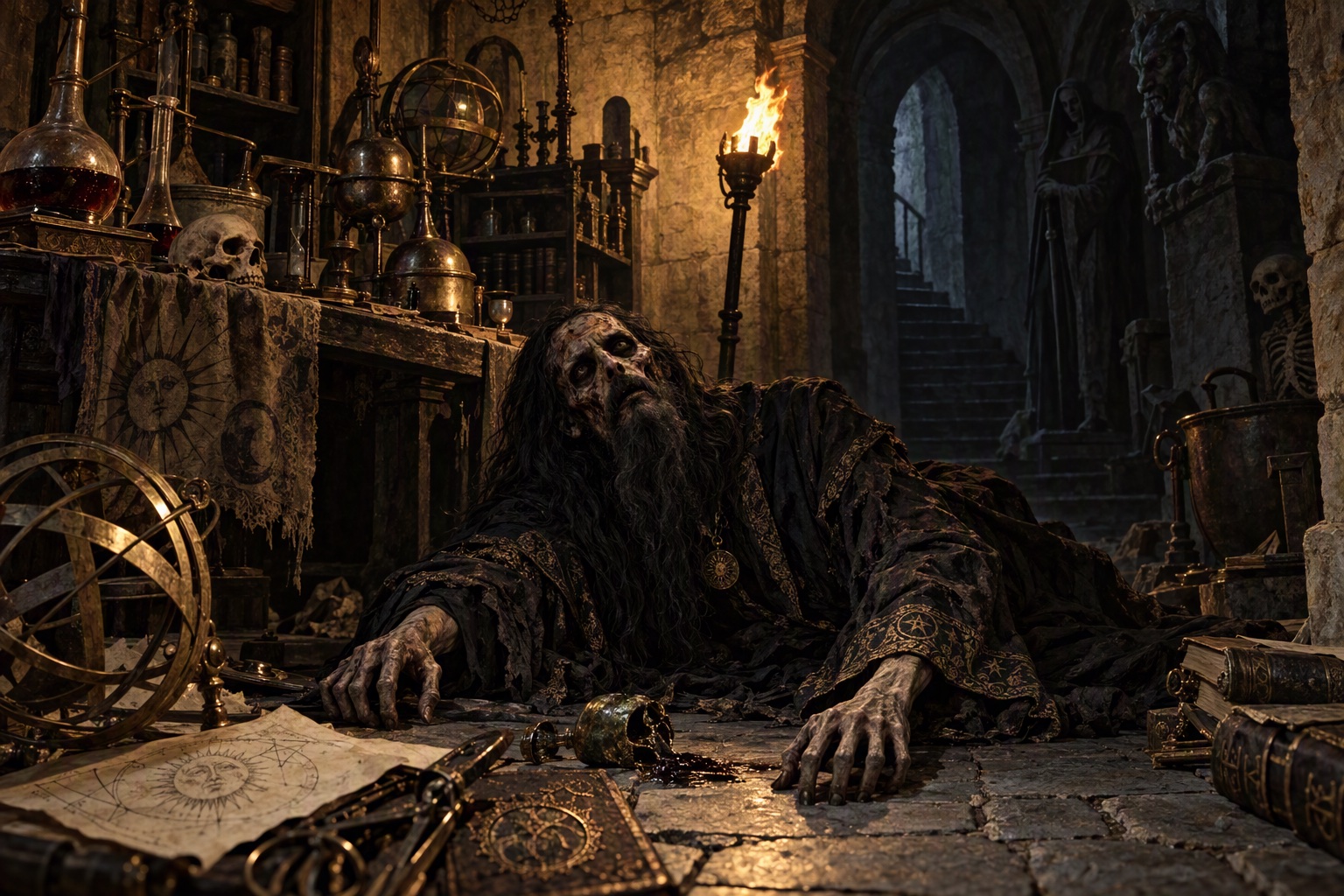
Le sensazioni che provai in quel momento sfuggono a ogni analisi. Trovarmi di fronte, in un luogo che avevo creduto così completamente deserto come l’antico castello, alla prova della presenza di un uomo o di uno spirito suscitò nella mia mente un orrore della più acuta intensità. Quando finalmente mi voltai verso la fonte del rumore, i miei occhi dovettero quasi schizzarmi dalle orbite alla vista che mi si presentò. Là, nell’antico portale gotico, stava una figura umana. Era quella di un uomo vestito di una calotta e di una lunga tunica medievale di colore scuro. I lunghi capelli e la barba fluente erano di un nero intenso e terribile, e di una foltezza incredibile. La fronte, più alta del normale, le guance, profondamente incavate e solcate da fitte rughe, e le mani, lunghe, simili ad artigli e nodose, avevano un pallore mortale, simile a quello del marmo, quale non avevo mai visto in nessun altro uomo. La figura, magra fino ad avere le proporzioni di uno scheletro, era stranamente curva e quasi scompariva nelle ampie pieghe del suo singolare abito. Ma ciò che più di ogni altra cosa colpiva erano gli occhi: due caverne di tenebra abissale, profonde nell’espressione d’intelligenza, eppure inumane nella misura della loro malvagità. Ora erano fissi su di me, mi trafiggevano l’anima con il loro odio e mi inchiodavano al luogo in cui mi trovavo.
Alla fine, la figura parlò con una voce cavernosa, il cui cupo vuoto e la malvagità latente mi gelarono fin nel profondo. La lingua in cui era formulato il discorso era quella forma corrotta di latino in uso fra gli uomini più dotti del Medioevo, che mi era divenuta familiare grazie alle mie prolungate ricerche nelle opere degli antichi alchimisti e demonologi. L’apparizione parlò della maledizione che incombeva sulla mia casata, mi annunciò la prossima fine, si soffermò sul torto perpetrato dal mio antenato ai danni del vecchio Michel Mauvais e si compiacque della vendetta di Charles Le Sorcier. Mi raccontò come il giovane Charles fosse fuggito nella notte, per tornare anni dopo e uccidere con una freccia Godfrey, l’erede, proprio mentre si avvicinava all’età che suo padre aveva raggiunto quando era stato assassinato, come fosse poi tornato segretamente nella tenuta e si fosse stabilito, senza essere scoperto, nella camera sotterranea allora già abbandonata da tempo, la cui porta ora incorniciava l’orrendo narratore, come avesse sorpreso Robert, figlio di Godfrey, in un campo, gli avesse forzato in gola del veleno e lo avesse lasciato morire all’età di trentadue anni, dando così compimento alle empie clausole della sua maledizione vendicativa.
A quel punto non potei fare a meno di chiedermi quale fosse la soluzione del più grande di tutti i misteri: come mai la maledizione avesse continuato ad avverarsi anche dopo il tempo in cui Charles Le Sorcier, secondo il corso naturale delle cose, doveva essere morto. L’uomo, infatti, si allontanò dall’argomento per parlare degli approfonditi studi alchemici condotti dai due stregoni, padre e figlio, soffermandosi in particolare sulle ricerche di Charles Le Sorcier intorno all’elisir che avrebbe concesso la vita e la giovinezza eterne a chiunque ne avesse bevuto.
Il suo entusiasmo sembrò, per un istante, cancellare dai suoi occhi terribili l’odio che fino ad allora li aveva così sinistramente abitati, ma d’un tratto il bagliore diabolico tornò ad accendersi, e con un suono agghiacciante, simile al sibilo d’un serpente, lo straniero sollevò una fiala di vetro, evidentemente deciso a porre fine alla mia vita, come Charles Le Sorcier aveva posto fine, seicento anni prima, a quella del mio antenato. Spinto da un istinto di conservazione e di autodifesa, spezzai l’incantesimo che fino ad allora mi aveva tenuto immobile e scagliai la torcia, ormai prossima a spegnersi, contro la creatura che minacciava la mia esistenza. Udii la fiala infrangersi senza danno contro le pietre del corridoio, mentre la tunica dello strano individuo prendeva fuoco, illuminando la scena orrenda di un livido chiarore. L’urlo di terrore e d’impotente malvagità lanciato dal mancato assassino fu troppo per i miei nervi, già scossi oltre misura, e caddi bocconi sul pavimento viscido, svenuto del tutto.
Quando finalmente ripresi i sensi, era tutto spaventosamente buio e la mia mente, rammentando ciò che era accaduto, rifuggiva dall’idea di assistere ad altro, eppure, la curiosità ebbe il sopravvento. Chi era, mi chiesi, quell’uomo malvagio, e come aveva fatto a penetrare entro le mura del castello? Perché avrebbe dovuto cercare di vendicare la morte del povero Michel Mauvais, e come aveva fatto la maledizione a perpetuarsi per tutti i lunghi secoli trascorsi dai tempi di Charles Le Sorcier? Il terrore che per anni mi aveva oppresso era stato sollevato dalle mie spalle, poiché sapevo che colui che avevo abbattuto era la fonte di ogni pericolo legato alla maledizione, e ora che ero libero, ardevo dal desiderio di saperne di più sulla sinistra creatura che aveva infestato la mia stirpe per secoli, trasformando la mia stessa giovinezza in un interminabile incubo. Deciso a proseguire l’esplorazione, frugai nelle tasche in cerca di pietra focaia e acciarino, e accesi la torcia di riserva che avevo portato con me. La nuova luce rivelò anzitutto la figura contorta e annerita dello straniero misterioso. I suoi occhi orrendi erano ormai chiusi. Incapace di sopportarne la vista, mi voltai ed entrai nella camera oltre la porta gotica. Vi trovai quello che sembrava proprio il laboratorio di un alchimista. In un angolo si ammassava un’enorme quantità di metallo giallo e lucente, che scintillava magnificamente alla luce della torcia. Poteva essere oro, ma non mi fermai a esaminarlo, tanto ero stranamente sconvolto da ciò che avevo appena vissuto. All’estremità opposta della stanza si apriva un passaggio che dava su uno dei numerosi burroni selvaggi del bosco oscuro che rivestiva il fianco della collina. Pieno di stupore, ma ormai consapevole di come quell’uomo fosse riuscito a introdursi nel castello, mi accinsi a tornare indietro. Avevo intenzione di passare oltre i resti dello straniero senza guardarli, ma, mentre mi avvicinavo al corpo, mi parve di udire provenire da esso un debole suono, come se la vita non si fosse ancora del tutto spenta. Inorridito, mi voltai a esaminare la figura carbonizzata e raggrinzita sul pavimento. All’improvviso, gli occhi orribili, ancor più neri del volto bruciato in cui erano incastonati, si spalancarono, con un’espressione che non riuscii a decifrare. Le labbra screpolate cercarono di articolare parole che non riuscivo a comprendere bene. Una volta colsi il nome di Charles Le Sorcier, un’altra, mi parve di udire le parole «anni» e «maledizione» uscire da quella bocca contorta. Non riuscivo tuttavia a cogliere il senso del suo discorso sconnesso. Vedendo che non comprendevo ciò che intendeva dire, quegli occhi neri come la pece tornarono a lampeggiare con malignità, e io, pur rendendomi conto dell’impotenza del mio avversario, tremavo nel guardarlo.
D’un tratto, il miserabile, animato da un ultimo impeto di forza, sollevò l’orrenda testa dal pavimento umido e avvallato. Poi, mentre io restavo paralizzato dalla paura, ritrovò la voce e, con l’ultimo respiro, urlò quelle parole che da allora avrebbero infestato per sempre i miei giorni e le mie notti.
«Stolto!» gridò. «Non riesci a indovinare il mio segreto? Non hai intelletto sufficiente per riconoscere la volontà che, attraverso sei lunghi secoli, ha dato compimento alla terribile maledizione gravante sulla tua casata? Non ti ho forse parlato del grande elisir della vita eterna? Non sai come sia stato svelato il segreto dell’Alchimia? Te lo dico io: sono io! Io! IO, che ho vissuto per seicento anni per perpetuare la mia vendetta, PERCHÉ IO SONO CHARLES LE SORCIER!»
H.P. Lovecraft (1908)
Traduzione dall’inglese: ChatGPT
High up, crowning the grassy summit of a swelling mound whose sides are wooded near the base with the gnarled trees of the primeval forest, stands the old chateau of my ancestors. For centuries its lofty battlements have frowned down upon the wild and rugged countryside about, serving as a home and stronghold for the proud house whose honoured line is older even than the moss-grown castle walls. These ancient turrets, stained by the storms of generations and crumbling under the slow yet mighty pressure of time, formed in the ages of feudalism one of the most dreaded and formidable fortresses in all France. From its machicolated parapets and mounted battlements Barons, Counts, and even Kings had been defied, yet never had its spacious halls resounded to the footsteps of the invader.
But since those glorious years all is changed. A poverty but little above the level of dire want, together with a pride of name that forbids its alleviation by the pursuits of commercial life, have prevented the scions of our line from maintaining their estates in pristine splendour; and the falling stones of the walls, the overgrown vegetation in the parks, the dry and dusty moat, the ill-paved courtyards, and toppling towers without, as well as the sagging floors, the worm-eaten wainscots, and the faded tapestries within, all tell a gloomy tale of fallen grandeur. As the ages passed, first one, then another of the four great turrets were left to ruin, until at last but a single tower housed the sadly reduced descendants of the once mighty lords of the estate.
It was in one of the vast and gloomy chambers of this remaining tower that I, Antoine, last of the unhappy and accursed Comtes de C——, first saw the light of day, ninety long years ago. Within these walls, and amongst the dark and shadowy forests, the wild ravines and grottoes of the hillside below, were spent the first years of my troubled life. My parents I never knew. My father had been killed at the age of thirty-two, a month before I was born, by the fall of a stone somehow dislodged from one of the deserted parapets of the castle; and my mother having died at my birth, my care and education devolved solely upon one remaining servitor, an old and trusted man of considerable intelligence, whose name I remember as Pierre. I was an only child, and the lack of companionship which this fact entailed upon me was augmented by the strange care exercised by my aged guardian in excluding me from the society of the peasant children whose abodes were scattered here and there upon the plains that surround the base of the hill. At the time, Pierre said that this restriction was imposed upon me because my noble birth placed me above association with such plebeian company. Now I know that its real object was to keep from my ears the idle tales of the dread curse upon our line, that were nightly told and magnified by the simple tenantry as they conversed in hushed accents in the glow of their cottage hearths.
Thus isolated, and thrown upon my own resources, I spent the hours of my childhood in poring over the ancient tomes that filled the shadow-haunted library of the chateau, and in roaming without aim or purpose through the perpetual dusk of the spectral wood that clothes the side of the hill near its foot. It was perhaps an effect of such surroundings that my mind early acquired a shade of melancholy. Those studies and pursuits which partake of the dark and occult in Nature most strongly claimed my attention.
Of my own race I was permitted to learn singularly little, yet what small knowledge of it I was able to gain, seemed to depress me much. Perhaps it was at first only the manifest reluctance of my old preceptor to discuss with me my paternal ancestry that gave rise to the terror which I ever felt at the mention of my great house; yet as I grew out of childhood, I was able to piece together disconnected fragments of discourse, let slip from the unwilling tongue which had begun to falter in approaching senility, that had a sort of relation to a certain circumstance which I had always deemed strange, but which now became dimly terrible. The circumstance to which I allude is the early age at which all the Comtes of my line had met their end. Whilst I had hitherto considered this but a natural attribute of a family of short-lived men, I afterward pondered long upon these premature deaths, and began to connect them with the wanderings of the old man, who often spoke of a curse which for centuries had prevented the lives of the holders of my title from much exceeding the span of thirty-two years. Upon my twenty-first birthday, the aged Pierre gave to me a family document which he said had for many generations been handed down from father to son, and continued by each possessor. Its contents were of the most startling nature, and its perusal confirmed the gravest of my apprehensions. At this time, my belief in the supernatural was firm and deep-seated, else I should have dismissed with scorn the incredible narrative unfolded before my eyes.
The paper carried me back to the days of the thirteenth century, when the old castle in which I sat had been a feared and impregnable fortress. It told of a certain ancient man who had once dwelt on our estates, a person of no small accomplishments, though little above the rank of peasant; by name, Michel, usually designated by the surname of Mauvais, the Evil, on account of his sinister reputation. He had studied beyond the custom of his kind, seeking such things as the Philosopher’s Stone, or the Elixir of Eternal Life, and was reputed wise in the terrible secrets of Black Magic and Alchemy. Michel Mauvais had one son, named Charles, a youth as proficient as himself in the hidden arts, and who had therefore been called Le Sorcier, or the Wizard. This pair, shunned by all honest folk, were suspected of the most hideous practices. Old Michel was said to have burnt his wife alive as a sacrifice to the Devil, and the unaccountable disappearances of many small peasant children were laid at the dreaded door of these two. Yet through the dark natures of the father and the son ran one redeeming ray of humanity; the evil old man loved his offspring with fierce intensity, whilst the youth had for his parent a more than filial affection.
One night the castle on the hill was thrown into the wildest confusion by the vanishment of young Godfrey, son to Henri the Comte. A searching party, headed by the frantic father, invaded the cottage of the sorcerers and there came upon old Michel Mauvais, busy over a huge and violently boiling cauldron. Without certain cause, in the ungoverned madness of fury and despair, the Comte laid hands on the aged wizard, and ere he released his murderous hold his victim was no more. Meanwhile joyful servants were proclaiming the finding of young Godfrey in a distant and unused chamber of the great edifice, telling too late that poor Michel had been killed in vain. As the Comte and his associates turned away from the lowly abode of the alchemists, the form of Charles Le Sorcier appeared through the trees. The excited chatter of the menials standing about told him what had occurred, yet he seemed at first unmoved at his father’s fate. Then, slowly advancing to meet the Comte, he pronounced in dull yet terrible accents the curse that ever afterward haunted the house of C——.
| “May ne’er a noble of thy murd’rous line Survive to reach a greater age than thine!” |
spake he, when, suddenly leaping backwards into the black wood, he drew from his tunic a phial of colourless liquid which he threw into the face of his father’s slayer as he disappeared behind the inky curtain of the night. The Comte died without utterance, and was buried the next day, but little more than two and thirty years from the hour of his birth. No trace of the assassin could be found, though relentless bands of peasants scoured the neighbouring woods and the meadow-land around the hill.
Thus time and the want of a reminder dulled the memory of the curse in the minds of the late Comte’s family, so that when Godfrey, innocent cause of the whole tragedy and now bearing the title, was killed by an arrow whilst hunting, at the age of thirty-two, there were no thoughts save those of grief at his demise. But when, years afterward, the next young Comte, Robert by name, was found dead in a nearby field from no apparent cause, the peasants told in whispers that their seigneur had but lately passed his thirty-second birthday when surprised by early death. Louis, son to Robert, was found drowned in the moat at the same fateful age, and thus down through the centuries ran the ominous chronicle; Henris, Roberts, Antoines, and Armands snatched from happy and virtuous lives when little below the age of their unfortunate ancestor at his murder.
That I had left at most but eleven years of further existence was made certain to me by the words which I read. My life, previously held at small value, now became dearer to me each day, as I delved deeper and deeper into the mysteries of the hidden world of black magic. Isolated as I was, modern science had produced no impression upon me, and I laboured as in the Middle Ages, as wrapt as had been old Michel and young Charles themselves in the acquisition of daemonological and alchemical learning. Yet read as I might, in no manner could I account for the strange curse upon my line. In unusually rational moments, I would even go so far as to seek a natural explanation, attributing the early deaths of my ancestors to the sinister Charles Le Sorcier and his heirs; yet having found upon careful inquiry that there were no known descendants of the alchemist, I would fall back to occult studies, and once more endeavour to find a spell that would release my house from its terrible burden. Upon one thing I was absolutely resolved. I should never wed, for since no other branches of my family were in existence, I might thus end the curse with myself.
As I drew near the age of thirty, old Pierre was called to the land beyond. Alone I buried him beneath the stones of the courtyard about which he had loved to wander in life. Thus was I left to ponder on myself as the only human creature within the great fortress, and in my utter solitude my mind began to cease its vain protest against the impending doom, to become almost reconciled to the fate which so many of my ancestors had met. Much of my time was now occupied in the exploration of the ruined and abandoned halls and towers of the old chateau, which in youth fear had caused me to shun, and some of which, old Pierre had once told me, had not been trodden by human foot for over four centuries. Strange and awesome were many of the objects I encountered. Furniture, covered by the dust of ages and crumbling with the rot of long dampness, met my eyes. Cobwebs in a profusion never before seen by me were spun everywhere, and huge bats flapped their bony and uncanny wings on all sides of the otherwise untenanted gloom.
Of my exact age, even down to days and hours, I kept a most careful record, for each movement of the pendulum of the massive clock in the library told off so much more of my doomed existence. At length I approached that time which I had so long viewed with apprehension. Since most of my ancestors had been seized some little while before they reached the exact age of Comte Henri at his end, I was every moment on the watch for the coming of the unknown death. In what strange form the curse should overtake me, I knew not; but I was resolved, at least, that it should not find me a cowardly or a passive victim. With new vigour I applied myself to my examination of the old chateau and its contents.
It was upon one of the longest of all my excursions of discovery in the deserted portion of the castle, less than a week before that fatal hour which I felt must mark the utmost limit of my stay on earth, beyond which I could have not even the slightest hope of continuing to draw breath, that I came upon the culminating event of my whole life. I had spent the better part of the morning in climbing up and down half-ruined staircases in one of the most dilapidated of the ancient turrets. As the afternoon progressed, I sought the lower levels, descending into what appeared to be either a mediaeval place of confinement, or a more recently excavated storehouse for gunpowder. As I slowly traversed the nitre-encrusted passageway at the foot of the last staircase, the paving became very damp, and soon I saw by the light of my flickering torch that a blank, water-stained wall impeded my journey. Turning to retrace my steps, my eye fell upon a small trap-door with a ring, which lay directly beneath my feet. Pausing, I succeeded with difficulty in raising it, whereupon there was revealed a black aperture, exhaling noxious fumes which caused my torch to sputter, and disclosing in the unsteady glare the top of a flight of stone steps. As soon as the torch, which I lowered into the repellent depths, burned freely and steadily, I commenced my descent. The steps were many, and led to a narrow stone-flagged passage which I knew must be far underground. The passage proved of great length, and terminated in a massive oaken door, dripping with the moisture of the place, and stoutly resisting all my attempts to open it. Ceasing after a time my efforts in this direction, I had proceeded back some distance toward the steps, when there suddenly fell to my experience one of the most profound and maddening shocks capable of reception by the human mind. Without warning, I heard the heavy door behind me creak slowly open upon its rusted hinges. My immediate sensations are incapable of analysis. To be confronted in a place as thoroughly deserted as I had deemed the old castle with evidence of the presence of man or spirit, produced in my brain a horror of the most acute description. When at last I turned and faced the seat of the sound, my eyes must have started from their orbits at the sight that they beheld. There in the ancient Gothic doorway stood a human figure. It was that of a man clad in a skull-cap and long mediaeval tunic of dark colour. His long hair and flowing beard were of a terrible and intense black hue, and of incredible profusion. His forehead, high beyond the usual dimensions; his cheeks, deep-sunken and heavily lined with wrinkles; and his hands, long, claw-like, and gnarled, were of such a deathly, marble-like whiteness as I have never elsewhere seen in man. His figure, lean to the proportions of a skeleton, was strangely bent and almost lost within the voluminous folds of his peculiar garment. But strangest of all were his eyes; twin caves of abysmal blackness, profound in expression of understanding, yet inhuman in degree of wickedness. These were now fixed upon me, piercing my soul with their hatred, and rooting me to the spot whereon I stood. At last the figure spoke in a rumbling voice that chilled me through with its dull hollowness and latent malevolence. The language in which the discourse was clothed was that debased form of Latin in use amongst the more learned men of the Middle Ages, and made familiar to me by my prolonged researches into the works of the old alchemists and daemonologists. The apparition spoke of the curse which had hovered over my house, told me of my coming end, dwelt on the wrong perpetrated by my ancestor against old Michel Mauvais, and gloated over the revenge of Charles Le Sorcier. He told how the young Charles had escaped into the night, returning in after years to kill Godfrey the heir with an arrow just as he approached the age which had been his father’s at his assassination; how he had secretly returned to the estate and established himself, unknown, in the even then deserted subterranean chamber whose doorway now framed the hideous narrator; how he had seized Robert, son of Godfrey, in a field, forced poison down his throat, and left him to die at the age of thirty-two, thus maintaining the foul provisions of his vengeful curse. At this point I was left to imagine the solution of the greatest mystery of all, how the curse had been fulfilled since that time when Charles Le Sorcier must in the course of Nature have died, for the man digressed into an account of the deep alchemical studies of the two wizards, father and son, speaking most particularly of the researches of Charles Le Sorcier concerning the elixir which should grant to him who partook of it eternal life and youth.
His enthusiasm had seemed for the moment to remove from his terrible eyes the hatred that had at first so haunted them, but suddenly the fiendish glare returned, and with a shocking sound like the hissing of a serpent, the stranger raised a glass phial with the evident intent of ending my life as had Charles Le Sorcier, six hundred years before, ended that of my ancestor. Prompted by some preserving instinct of self-defence, I broke through the spell that had hitherto held me immovable, and flung my now dying torch at the creature who menaced my existence. I heard the phial break harmlessly against the stones of the passage as the tunic of the strange man caught fire and lit the horrid scene with a ghastly radiance. The shriek of fright and impotent malice emitted by the would-be assassin proved too much for my already shaken nerves, and I fell prone upon the slimy floor in a total faint.
When at last my senses returned, all was frightfully dark, and my mind remembering what had occurred, shrank from the idea of beholding more; yet curiosity overmastered all. Who, I asked myself, was this man of evil, and how came he within the castle walls? Why should he seek to avenge the death of poor Michel Mauvais, and how had the curse been carried on through all the long centuries since the time of Charles Le Sorcier? The dread of years was lifted from my shoulders, for I knew that he whom I had felled was the source of all my danger from the curse; and now that I was free, I burned with the desire to learn more of the sinister thing which had haunted my line for centuries, and made of my own youth one long-continued nightmare. Determined upon further exploration, I felt in my pockets for flint and steel, and lit the unused torch which I had with me. First of all, the new light revealed the distorted and blackened form of the mysterious stranger. The hideous eyes were now closed. Disliking the sight, I turned away and entered the chamber beyond the Gothic door. Here I found what seemed much like an alchemist’s laboratory. In one corner was an immense pile of a shining yellow metal that sparkled gorgeously in the light of the torch. It may have been gold, but I did not pause to examine it, for I was strangely affected by that which I had undergone. At the farther end of the apartment was an opening leading out into one of the many wild ravines of the dark hillside forest. Filled with wonder, yet now realising how the man had obtained access to the chateau, I proceeded to return. I had intended to pass by the remains of the stranger with averted face, but as I approached the body, I seemed to hear emanating from it a faint sound, as though life were not yet wholly extinct. Aghast, I turned to examine the charred and shrivelled figure on the floor. Then all at once the horrible eyes, blacker even than the seared face in which they were set, opened wide with an expression which I was unable to interpret. The cracked lips tried to frame words which I could not well understand. Once I caught the name of Charles Le Sorcier, and again I fancied that the words “years” and “curse” issued from the twisted mouth. Still I was at a loss to gather the purport of his disconnected speech. At my evident ignorance of his meaning, the pitchy eyes once more flashed malevolently at me, until, helpless as I saw my opponent to be, I trembled as I watched him.
Suddenly the wretch, animated with his last burst of strength, raised his hideous head from the damp and sunken pavement. Then, as I remained, paralysed with fear, he found his voice and in his dying breath screamed forth those words which have ever afterward haunted my days and my nights. “Fool,” he shrieked, “can you not guess my secret? Have you no brain whereby you may recognise the will which has through six long centuries fulfilled the dreadful curse upon your house? Have I not told you of the great elixir of eternal life? Know you not how the secret of Alchemy was solved? I tell you, it is I! I! I! that have lived for six hundred years to maintain my revenge, FOR I AM CHARLES LE SORCIER!”
H.P. Lovecraft (1908)
Original version

Lascia un commento
Devi essere connesso per inviare un commento.
 Lucien


Lascia un commento
Devi essere connesso per inviare un commento.