 Lucien
- La Nave Bianca (Versione italiana) 18~26 min
- The White Ship (English version) 18~26 min
Mi chiamo Basil Elton e sono il custode del faro di North Point, che mio padre e mio nonno custodirono prima di me. Lontano dalla riva sorge il grigio faro, sopra scogli viscidi e sommersi, visibili quando la marea è bassa, ma celati quando essa si leva. Da un secolo, dinanzi a quel segnale, sono passati i maestosi velieri dei sette mari.
Ai tempi di mio nonno erano numerosi; ai tempi di mio padre erano già meno; e ora ne rimangono così pochi che talvolta mi sento stranamente solo, quasi fossi l’ultimo uomo rimasto sul nostro pianeta.
Dalle rive lontane giungevano, un tempo, quelle argentee flotte dalle vele bianche; dalle remote coste d’Oriente, dove brillano soli caldi e dolci profumi aleggiavano intorno a giardini insoliti e a templi festosi. Gli antichi capitani del mare andavano spesso da mio nonno e gli narravano di quelle terre; mio nonno, a sua volta, ne parlava a mio padre, e mio padre a me, durante le lunghe sere autunnali, quando il vento ululava sinistramente da oriente.
Ho letto altre cose ancora su quei luoghi, e su molte altre meraviglie, nei libri che gli uomini mi donarono quando ero giovane e colmo di stupore.
Ma più meravigliosa del sapere degli anziani e della sapienza racchiusa nei libri è la conoscenza segreta dell’oceano. Azzurro, verde, grigio, bianco o nero; liscio, increspato o montuoso, l’oceano non è silenzioso. Per tutta la vita l’ho osservato e ascoltato, e ormai lo conosco bene. Dapprima mi raccontava soltanto le semplici, modeste storie di spiagge tranquille e porti vicini; ma, col passare degli anni, divenne più confidente e mi parlò d’altre cose, di cose più strane e più remote nello spazio e nel tempo.
Talvolta, al crepuscolo, i grigi vapori dell’orizzonte si sono dischiusi, concedendomi fugaci visioni delle vie che si stendono oltre; altre volte, di notte, le profonde acque del mare si sono fatte limpide e fosforescenti, permettendomi di scorgere le vie che si trovano al di sotto. E tali visioni mi hanno mostrato tanto le vie che furono e quelle che potrebbero essere, quanto quelle che sono; poiché l’oceano è più antico delle montagne e reca con sé i ricordi e i sogni del Tempo.
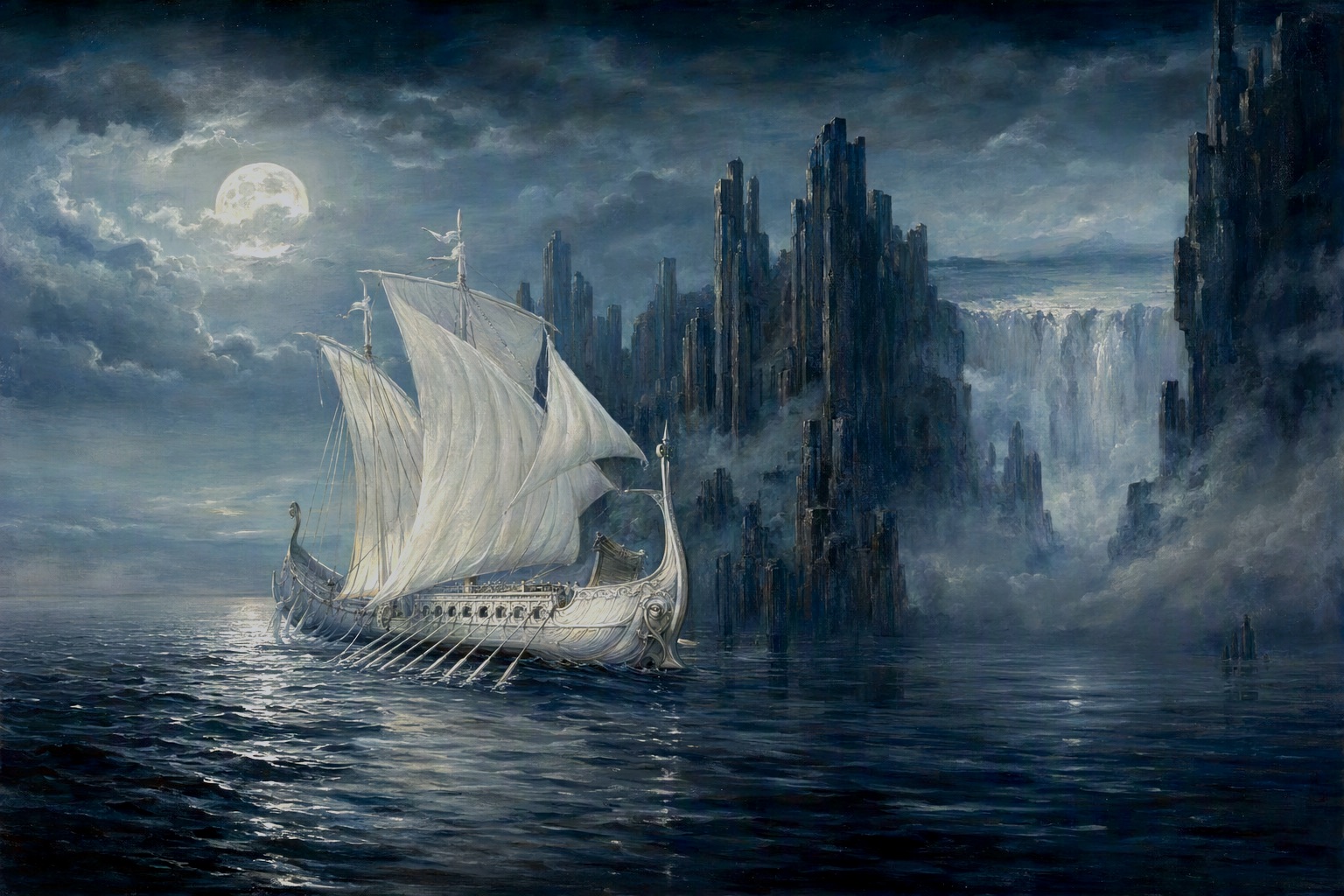
Era dal Sud che la Nave Bianca soleva giungere, quando la luna splendeva alta e piena nel cielo. Dal Sud scivolava sul mare, con moto dolcissimo e silenzioso. E che il mare fosse agitato o calmo, che il vento le fosse favorevole o contrario, essa avanzava sempre con la medesima dolcezza e nel medesimo silenzio, le vele lontane e le sue lunghe, strane file di remi in ritmico movimento.
Una notte scorsi sul ponte un uomo barbuto, avvolto in una veste, che pareva invitarmi a salire a bordo per raggiungere splendide rive sconosciute. Molte volte, in seguito, lo vidi sotto la luna piena, e ogni volta egli mi faceva cenno di seguirlo.
La luna brillava vivissima nella notte in cui risposi al richiamo, e camminai sulle acque fino alla Nave Bianca, sopra un ponte di raggi lunari. L’uomo che mi aveva invitato mi accolse allora con parole di benvenuto, in una lingua dolce che mi pareva di conoscere assai bene; e le ore trascorsero accompagnate dai sommessi canti dei rematori, mentre scivolavamo verso un misterioso Sud, dorato dal fulgore di quella luna piena e mite.
Quando spuntò il giorno, roseo e splendente, vidi la verde costa di terre lontane, luminose, bellissime e a me ignote. Dal mare si levavano maestose terrazze di verzura, punteggiate d’alberi, qua e là ornate dai candidi tetti e dai colonnati scintillanti di templi sconosciuti. Mentre ci avvicinavamo alla verde riva, l’uomo barbuto mi parlò di quella terra, il Paese di Zar, dove dimorano tutti i sogni e i pensieri di bellezza che visitano gli uomini una sola volta, per poi essere dimenticati.
Quando tornai a guardare le terrazze, compresi che le sue parole erano vere; poiché fra gli spettacoli che mi si offrivano alla vista riconobbi molte cose che avevo già intravisto nelle nebbie oltre l’orizzonte e nelle profondità fosforescenti dell’oceano. Vi erano inoltre forme e fantasie più splendide di qualsiasi altra da me conosciuta: le visioni dei giovani poeti morti nella miseria, prima che il mondo potesse apprendere ciò che avevano veduto e sognato.
Ma non mettemmo piede sui prati in pendio di Zar, poiché si narra che chiunque li calpesti non possa mai più fare ritorno alla propria terra.
Mentre la Nave Bianca si allontanava silenziosamente dalle terrazze di Zar, ornate di templi, scorgemmo sull’orizzonte lontano, dinanzi a noi, le guglie di una città possente; e l’uomo barbuto mi disse:
«Questa è Thalarion, la Città delle Mille Meraviglie, dove dimorano tutti quei misteri che l’uomo ha invano cercato di penetrare».
Guardai di nuovo, più da vicino, e vidi che la città superava in grandezza qualsiasi altra città avessi mai conosciuto o immaginato.
Le guglie dei suoi templi si levavano tanto in alto nel cielo che nessun uomo avrebbe potuto scorgerne le sommità; e ben oltre l’orizzonte si stendevano le cupe mura grigie, al di sopra delle quali si distinguevano soltanto pochi tetti, strani e minacciosi, eppure ornati di ricchi fregi e seducenti sculture.
Desideravo ardentemente entrare in quella città tanto affascinante quanto repellente, e supplicai l’uomo barbuto di farmi sbarcare presso il molo di pietra, accanto all’enorme porta scolpita di Akariel. Ma egli respinse gentilmente la mia richiesta, dicendo:
«Molti sono entrati a Thalarion, la Città delle Mille Meraviglie, ma nessuno ne è mai tornato. Vi vagano soltanto demoni ed esseri folli, che non sono più uomini, e le strade sono bianche delle ossa insepolte di coloro che hanno contemplato l’eidolon Lathi, signora della città».
Così la Nave Bianca proseguì oltre le mura di Thalarion e seguì per molti giorni un uccello diretto verso sud, il cui piumaggio lucente aveva lo stesso colore del cielo da cui era apparso.
Giungemmo quindi a una costa amena, festosa di fiori d’ogni tinta, dove, fin dove potevamo scorgere nell’entroterra, si stendevano al sole meridiano incantevoli boschetti e splendidi pergolati. Da padiglioni nascosti alla nostra vista giungevano improvvise esplosioni di canto e frammenti di melodie, interrotti da risate sommesse tanto deliziose che, nell’ansia di raggiungere quel luogo, esortai i rematori a procedere più in fretta. L’uomo barbuto non disse parola, ma mi osservò mentre ci avvicinavamo alla riva orlata di gigli.
All’improvviso, un vento proveniente dai prati fioriti e dai boschi frondosi portò con sé un odore che mi fece rabbrividire. Il vento si rafforzò, e l’aria si riempì del fetore mortale, simile a quello dei sepolcri, che si leva dalle città devastate dalla peste e dai cimiteri scoperchiati. E mentre fuggivamo impetuosamente da quella costa maledetta, l’uomo barbuto parlò finalmente, dicendo:
«Questa è Xura, la Terra dei Piaceri Irraggiungibili».
Ancora una volta, dunque, la Nave Bianca seguì l’uccello celeste, attraversando mari tiepidi e beati, carezzati da brezze aromatiche. Navigammo giorno dopo giorno e notte dopo notte; e quando la luna era piena ascoltavamo i dolci canti dei rematori, soavi come in quella lontana notte in cui avevamo lasciato la mia remota terra natale. Fu ancora alla luce della luna che infine gettammo l’ancora nel porto di Sona-Nyl, custodito da due promontori di cristallo che s’innalzavano dal mare e si congiungevano formando un arco splendente.
Questa è la Terra della Fantasia, e raggiungemmo la verde riva camminando sopra un ponte dorato di raggi lunari.
Nella terra di Sona-Nyl non esistono né il tempo né lo spazio, né la sofferenza né la morte; e là dimorai per innumerevoli eoni. Verdi sono i boschetti e i pascoli, luminose e fragranti le corolle dei fiori, azzurri e melodiosi i ruscelli, limpide e fresche le fontane, maestosi e splendidi i templi, i castelli e le città di Sona-Nyl. Non vi sono confini a quella terra, poiché oltre ogni panorama di bellezza ne sorge un altro ancor più bello.
Per le campagne e in mezzo allo splendore delle città si aggirano liberamente gli abitanti felici, tutti dotati di grazia intatta e di gioia pura. Durante gli eoni che vi trascorsi, vagai in beata letizia attraverso giardini nei quali pagode bizzarre facevano capolino da gradevoli gruppi d’arbusti e candidi sentieri erano bordati da fiori delicati.
Scalai dolci colline, dalle cui sommità contemplavo panorami incantevoli, con città dalle guglie svettanti adagiate in verdi vallate e cupole dorate di città gigantesche scintillanti sull’orizzonte infinitamente lontano. E alla luce della luna ammiravo il mare scintillante, i promontori cristallini e il placido porto nel quale giaceva all’ancora la Nave Bianca.
Fu una notte, contro la luna piena, nell’immemorabile anno di Tharp, che vidi stagliarsi la figura invitante dell’uccello celeste e avvertii in me i primi fremiti d’inquietudine. Allora parlai con l’uomo barbuto e gli confidai il nuovo desiderio di partire per la remota Cathuria, che nessun uomo ha mai veduto, ma che tutti credono si trovi oltre le colonne di basalto dell’Occidente. È la Terra della Speranza, dove risplendono gli ideali perfetti di tutto ciò che conosciamo altrove; o almeno, così si racconta.
Ma l’uomo barbuto mi disse:
«Guardati da quei mari pericolosi nei quali gli uomini affermano che si trovi Cathuria. A Sona-Nyl non esistono dolore né morte, ma chi può sapere che cosa si nasconda oltre le colonne di basalto dell’Occidente?».
Nondimeno, alla successiva luna piena salii a bordo della Nave Bianca e, insieme all’uomo barbuto, che mi seguiva controvoglia, lasciai il porto felice per solcare mari mai esplorati.
L’uccello celeste volava davanti a noi e ci guidava verso le colonne di basalto dell’Occidente; ma questa volta i rematori non intonarono i loro dolci canti sotto la luna piena. Nella mia mente immaginavo spesso l’ignota Terra di Cathuria, con i suoi splendidi boschetti e palazzi, e mi domandavo quali nuove delizie mi attendessero. «Cathuria», dicevo fra me e me, «è la dimora degli dèi e la terra di innumerevoli città d’oro.
Le sue foreste sono di aloe e sandalo, come i fragranti boschetti di Camorin, e fra gli alberi svolazzano uccelli variopinti, dal canto soave. Sui monti verdi e fioriti di Cathuria sorgono templi di marmo rosa, ricchi di splendidi ornamenti scolpiti e dipinti; nei loro cortili si trovano fresche fontane d’argento, dove gorgogliano con musica rapitrice le acque profumate del fiume Narg, che sgorga dalle grotte. Le città di Cathuria sono cinte da mura d’oro, e d’oro sono anche i loro selciati.
Nei giardini di queste città crescono orchidee insolite e si stendono laghi profumati, i cui fondali sono di corallo e ambra. Di notte, le strade e i giardini sono illuminati da festose lanterne ricavate dal guscio tricolore della tartaruga; e tutt’intorno risuonano le dolci note dei cantori e dei liutisti. Le case delle città di Cathuria sono tutte palazzi, ciascuno costruito sopra un canale odoroso che trasporta le acque del sacro Narg.
Le dimore sono di marmo e porfido, e i tetti, d’oro scintillante, riflettono i raggi del sole, accrescendo lo splendore delle città mentre gli dèi beati le contemplano dalle vette lontane. Il più bello di tutti è il palazzo del grande sovrano Dorieb, che alcuni dicono semidio e altri dio. Alto è il palazzo di Dorieb, e numerose sono le torrette di marmo che si levano lungo le sue mura. Nei vasti saloni si radunano moltitudini, e alle pareti sono appesi i trofei dei secoli.
Il tetto è d’oro purissimo, sorretto da alte colonne di rubino e d’azzurro, e ornato di figure scolpite di dèi ed eroi tanto mirabili che chi leva lo sguardo verso quelle altezze crede di contemplare l’Olimpo vivente. Il pavimento del palazzo è di vetro, e sotto di esso scorrono le acque del Narg, abilmente illuminate e popolate da pesci sgargianti, sconosciuti oltre i confini della leggiadra Cathuria».
Così parlavo fra me e me di Cathuria; ma l’uomo barbuto mi esortava sempre a tornare alle felici rive di Sona-Nyl, poiché Sona-Nyl è conosciuta dagli uomini, mentre nessuno ha mai contemplato Cathuria.
E il trentunesimo giorno da quando seguivamo l’uccello, scorgemmo le colonne di basalto dell’Occidente. Erano avvolte nella nebbia, così che nessun uomo avrebbe potuto guardare oltre di esse o vederne le sommità, che, secondo alcuni, giungono fino al cielo.
L’uomo barbuto mi scongiurò ancora una volta di tornare indietro, ma non gli diedi ascolto; poiché dalle nebbie oltre le colonne di basalto mi parve giungessero le note di un cantore e di un liutista, più dolci dei canti più soavi di Sona-Nyl, e rivolte in mio elogio: in lode di me, che avevo viaggiato lontano sotto la luna piena e dimorato nella Terra della Fantasia.
Così, seguendo il suono della melodia, la Nave Bianca penetrò nella nebbia fra le colonne di basalto dell’Occidente. Quando la musica cessò e la nebbia si diradò, non vedemmo la Terra di Cathuria, bensì un mare impetuoso e irresistibile, sul quale la nostra inerme imbarcazione veniva trascinata verso una meta sconosciuta.
Ben presto giunse alle nostre orecchie il lontano fragore di acque precipitanti, e ai nostri occhi apparve, sull’orizzonte dinanzi a noi, la gigantesca nube di spruzzi di una cataratta mostruosa, nella quale gli oceani del mondo precipitano verso un abisso di nulla.
Allora l’uomo barbuto mi disse, con le lacrime sul volto:
«Abbiamo respinto la bella terra di Sona-Nyl, che forse non potremo mai più contemplare. Gli dèi sono più grandi degli uomini, e hanno vinto».
Chiusi gli occhi davanti allo schianto che sapevo imminente, sottraendomi alla vista dell’uccello celeste, che agitava beffardo le sue ali azzurre sopra l’orlo del precipizio.
Dallo schianto vennero le tenebre, e udii le grida strazianti degli uomini e di cose che uomini non erano. Da oriente si levarono venti tempestosi, che mi gelarono mentre me ne stavo rannicchiato sulla lastra di pietra umida sorta sotto i miei piedi. Poi, udendo un altro schianto, aprii gli occhi e mi ritrovai sulla piattaforma di quel faro dal quale ero salpato tanti eoni prima.
Nel buio sottostante si delineavano le vaste sagome indistinte di una nave che si sfasciava contro gli scogli crudeli; e volgendo lo sguardo al largo vidi che la luce si era spenta per la prima volta da quando mio nonno aveva assunto la custodia del faro.
Nelle ultime ore della notte, quando rientrai nella torre, vidi sulla parete un calendario che era rimasto esattamente com’era quando lo avevo lasciato, nell’ora in cui ero salpato. All’alba scesi dalla torre e cercai fra gli scogli i resti del naufragio, ma trovai soltanto queste cose: uno strano uccello morto, del colore del cielo azzurro, e un unico pennone spezzato, più bianco delle creste delle onde e della neve sui monti.
Da allora l’oceano non mi ha più rivelato i suoi segreti; e, sebbene la luna abbia brillato molte volte, piena e alta nel cielo, la Nave Bianca proveniente dal Sud non è mai più tornata.
H.P. Lovecraft (novembre 1919)
Traduzione dall’inglese: ChatGPT
Commento:
La sovra esposizione ai media e gadget elettronici ci toglie il potere dell’immaginazione e il piacere della fantasia.
I am Basil Elton, keeper of the North Point light that my father and grandfather kept before me. Far from the shore stands the grey lighthouse, above sunken slimy rocks that are seen when the tide is low, but unseen when the tide is high. Past that beacon for a century have swept the majestic barques of the seven seas. In the days of my grandfather there were many; in the days of my father not so many; and now there are so few that I sometimes feel strangely alone, as though I were the last man on our planet.
From far shores came those white-sailed argosies of old; from far Eastern shores where warm suns shine and sweet odours linger about strange gardens and gay temples. The old captains of the sea came often to my grandfather and told him of these things, which in turn he told to my father, and my father told to me in the long autumn evenings when the wind howled eerily from the East. And I have read more of these things, and of many things besides, in the books men gave me when I was young and filled with wonder.
But more wonderful than the lore of old men and the lore of books is the secret lore of ocean. Blue, green, grey, white, or black; smooth, ruffled, or mountainous; that ocean is not silent. All my days have I watched it and listened to it, and I know it well. At first it told to me only the plain little tales of calm beaches and near ports, but with the years it grew more friendly and spoke of other things; of things more strange and more distant in space and in time. Sometimes at twilight the grey vapours of the horizon have parted to grant me glimpses of the ways beyond; and sometimes at night the deep waters of the sea have grown clear and phosphorescent, to grant me glimpses of the ways beneath. And these glimpses have been as often of the ways that were and the ways that might be, as of the ways that are; for ocean is more ancient than the mountains, and freighted with the memories and the dreams of Time.
Out of the South it was that the White Ship used to come when the moon was full and high in the heavens. Out of the South it would glide very smoothly and silently over the sea. And whether the sea was rough or calm, and whether the wind was friendly or adverse, it would always glide smoothly and silently, its sails distant and its long strange tiers of oars moving rhythmically. One night I espied upon the deck a man, bearded and robed, and he seemed to beckon me to embark for fair unknown shores. Many times afterward I saw him under the full moon, and ever did he beckon me.
Very brightly did the moon shine on the night I answered the call, and I walked out over the waters to the White Ship on a bridge of moonbeams. The man who had beckoned now spoke a welcome to me in a soft language I seemed to know well, and the hours were filled with soft songs of the oarsmen as we glided away into a mysterious South, golden with the glow of that full, mellow moon.
And when the day dawned, rosy and effulgent, I beheld the green shore of far lands, bright and beautiful, and to me unknown. Up from the sea rose lordly terraces of verdure, tree-studded, and shewing here and there the gleaming white roofs and colonnades of strange temples. As we drew nearer the green shore the bearded man told me of that land, the Land of Zar, where dwell all the dreams and thoughts of beauty that come to men once and then are forgotten. And when I looked upon the terraces again I saw that what he said was true, for among the sights before me were many things I had once seen through the mists beyond the horizon and in the phosphorescent depths of ocean. There too were forms and fantasies more splendid than any I had ever known; the visions of young poets who died in want before the world could learn of what they had seen and dreamed. But we did not set foot upon the sloping meadows of Zar, for it is told that he who treads them may nevermore return to his native shore.
As the White Ship sailed silently away from the templed terraces of Zar, we beheld on the distant horizon ahead the spires of a mighty city; and the bearded man said to me: “This is Thalarion, the City of a Thousand Wonders, wherein reside all those mysteries that man has striven in vain to fathom.” And I looked again, at closer range, and saw that the city was greater than any city I had known or dreamed of before. Into the sky the spires of its temples reached, so that no man might behold their peaks; and far back beyond the horizon stretched the grim, grey walls, over which one might spy only a few roofs, weird and ominous, yet adorned with rich friezes and alluring sculptures. I yearned mightily to enter this fascinating yet repellent city, and besought the bearded man to land me at the stone pier by the huge carven gate Akariel; but he gently denied my wish, saying: “Into Thalarion, the City of a Thousand Wonders, many have passed but none returned. Therein walk only daemons and mad things that are no longer men, and the streets are white with the unburied bones of those who have looked upon the eidolon Lathi, that reigns over the city.” So the White Ship sailed on past the walls of Thalarion, and followed for many days a southward-flying bird, whose glossy plumage matched the sky out of which it had appeared.
Then came we to a pleasant coast gay with blossoms of every hue, where as far inland as we could see basked lovely groves and radiant arbours beneath a meridian sun. From bowers beyond our view came bursts of song and snatches of lyric harmony, interspersed with faint laughter so delicious that I urged the rowers onward in my eagerness to reach the scene. And the bearded man spoke no word, but watched me as we approached the lily-lined shore. Suddenly a wind blowing from over the flowery meadows and leafy woods brought a scent at which I trembled. The wind grew stronger, and the air was filled with the lethal, charnel odour of plague-stricken towns and uncovered cemeteries. And as we sailed madly away from that damnable coast the bearded man spoke at last, saying: “This is Xura, the Land of Pleasures Unattained.”
So once more the White Ship followed the bird of heaven, over warm blessed seas fanned by caressing, aromatic breezes. Day after day and night after night did we sail, and when the moon was full we would listen to soft songs of the oarsmen, sweet as on that distant night when we sailed away from my far native land. And it was by moonlight that we anchored at last in the harbour of Sona-Nyl, which is guarded by twin headlands of crystal that rise from the sea and meet in a resplendent arch. This is the Land of Fancy, and we walked to the verdant shore upon a golden bridge of moonbeams.
In the Land of Sona-Nyl there is neither time nor space, neither suffering nor death; and there I dwelt for many aeons. Green are the groves and pastures, bright and fragrant the flowers, blue and musical the streams, clear and cool the fountains, and stately and gorgeous the temples, castles, and cities of Sona-Nyl. Of that land there is no bound, for beyond each vista of beauty rises another more beautiful. Over the countryside and amidst the splendour of cities rove at will the happy folk, of whom all are gifted with unmarred grace and unalloyed happiness. For the aeons that I dwelt there I wandered blissfully through gardens where quaint pagodas peep from pleasing clumps of bushes, and where the white walks are bordered with delicate blossoms. I climbed gentle hills from whose summits I could see entrancing panoramas of loveliness, with steepled towns nestling in verdant valleys, and with the golden domes of gigantic cities glittering on the infinitely distant horizon. And I viewed by moonlight the sparkling sea, the crystal headlands, and the placid harbour wherein lay anchored the White Ship.
It was against the full moon one night in the immemorial year of Tharp that I saw outlined the beckoning form of the celestial bird, and felt the first stirrings of unrest. Then I spoke with the bearded man, and told him of my new yearnings to depart for remote Cathuria, which no man hath seen, but which all believe to lie beyond the basalt pillars of the West. It is the Land of Hope, and in it shine the perfect ideals of all that we know elsewhere; or at least so men relate. But the bearded man said to me: “Beware of those perilous seas wherein men say Cathuria lies. In Sona-Nyl there is no pain nor death, but who can tell what lies beyond the basalt pillars of the West?” Natheless at the next full moon I boarded the White Ship, and with the reluctant bearded man left the happy harbour for untravelled seas.
And the bird of heaven flew before, and led us toward the basalt pillars of the West, but this time the oarsmen sang no soft songs under the full moon. In my mind I would often picture the unknown Land of Cathuria with its splendid groves and palaces, and would wonder what new delights there awaited me. “Cathuria,” I would say to myself, “is the abode of gods and the land of unnumbered cities of gold. Its forests are of aloe and sandalwood, even as the fragrant groves of Camorin, and among the trees flutter gay birds sweet with song. On the green and flowery mountains of Cathuria stand temples of pink marble, rich with carven and painted glories, and having in their courtyards cool fountains of silver, where purl with ravishing music the scented waters that come from the grotto-born river Narg. And the cities of Cathuria are cinctured with golden walls, and their pavements also are of gold. In the gardens of these cities are strange orchids, and perfumed lakes whose beds are of coral and amber. At night the streets and the gardens are lit with gay lanthorns fashioned from the three-coloured shell of the tortoise, and here resound the soft notes of the singer and the lutanist. And the houses of the cities of Cathuria are all palaces, each built over a fragrant canal bearing the waters of the sacred Narg. Of marble and porphyry are the houses, and roofed with glittering gold that reflects the rays of the sun and enhances the splendour of the cities as blissful gods view them from the distant peaks. Fairest of all is the palace of the great monarch Dorieb, whom some say to be a demigod and others a god. High is the palace of Dorieb, and many are the turrets of marble upon its walls. In its wide halls many multitudes assemble, and here hang the trophies of the ages. And the roof is of pure gold, set upon tall pillars of ruby and azure, and having such carven figures of gods and heroes that he who looks up to those heights seems to gaze upon the living Olympus. And the floor of the palace is of glass, under which flow the cunningly lighted waters of the Narg, gay with gaudy fish not known beyond the bounds of lovely Cathuria.”
Thus would I speak to myself of Cathuria, but ever would the bearded man warn me to turn back to the happy shores of Sona-Nyl; for Sona-Nyl is known of men, while none hath ever beheld Cathuria.
And on the thirty-first day that we followed the bird, we beheld the basalt pillars of the West. Shrouded in mist they were, so that no man might peer beyond them or see their summits—which indeed some say reach even to the heavens. And the bearded man again implored me to turn back, but I heeded him not; for from the mists beyond the basalt pillars I fancied there came the notes of singer and lutanist; sweeter than the sweetest songs of Sona-Nyl, and sounding mine own praises; the praises of me, who had voyaged far under the full moon and dwelt in the Land of Fancy.
So to the sound of melody the White Ship sailed into the mist betwixt the basalt pillars of the West. And when the music ceased and the mist lifted, we beheld not the Land of Cathuria, but a swift-rushing resistless sea, over which our helpless barque was borne toward some unknown goal. Soon to our ears came the distant thunder of falling waters, and to our eyes appeared on the far horizon ahead the titanic spray of a monstrous cataract, wherein the oceans of the world drop down to abysmal nothingness. Then did the bearded man say to me with tears on his cheek: “We have rejected the beautiful Land of Sona-Nyl, which we may never behold again. The gods are greater than men, and they have conquered.” And I closed my eyes before the crash that I knew would come, shutting out the sight of the celestial bird which flapped its mocking blue wings over the brink of the torrent.
Out of that crash came darkness, and I heard the shrieking of men and of things which were not men. From the East tempestuous winds arose, and chilled me as I crouched on the slab of damp stone which had risen beneath my feet. Then as I heard another crash I opened my eyes and beheld myself upon the platform of that lighthouse from whence I had sailed so many aeons ago. In the darkness below there loomed the vast blurred outlines of a vessel breaking up on the cruel rocks, and as I glanced out over the waste I saw that the light had failed for the first time since my grandfather had assumed its care.
And in the later watches of the night, when I went within the tower, I saw on the wall a calendar which still remained as when I had left it at the hour I sailed away. With the dawn I descended the tower and looked for wreckage upon the rocks, but what I found was only this: a strange dead bird whose hue was as of the azure sky, and a single shattered spar, of a whiteness greater than that of the wave-tips or of the mountain snow.
And thereafter the ocean told me its secrets no more; and though many times since has the moon shone full and high in the heavens, the White Ship from the South came never again.
H.P. Lovecraft (November 1919)
Original version
Comment: Overexposure to media and electronic gadgets deprives us of the power of imagination and the joy of fantasy.

Lascia un commento
Devi essere connesso per inviare un commento.
 Lucien

Lascia un commento
Devi essere connesso per inviare un commento.